


Understanding an Isthmocele: A Hidden Cause of Pelvic Pain, Abnormal Bleeding, and Infertility
Sherley Samuels, MD, FACOG
Focused Practice Designation in Minimally Invasive Gynecologic Surgery (MIGS), American Board of Obstetrics and Gynecology
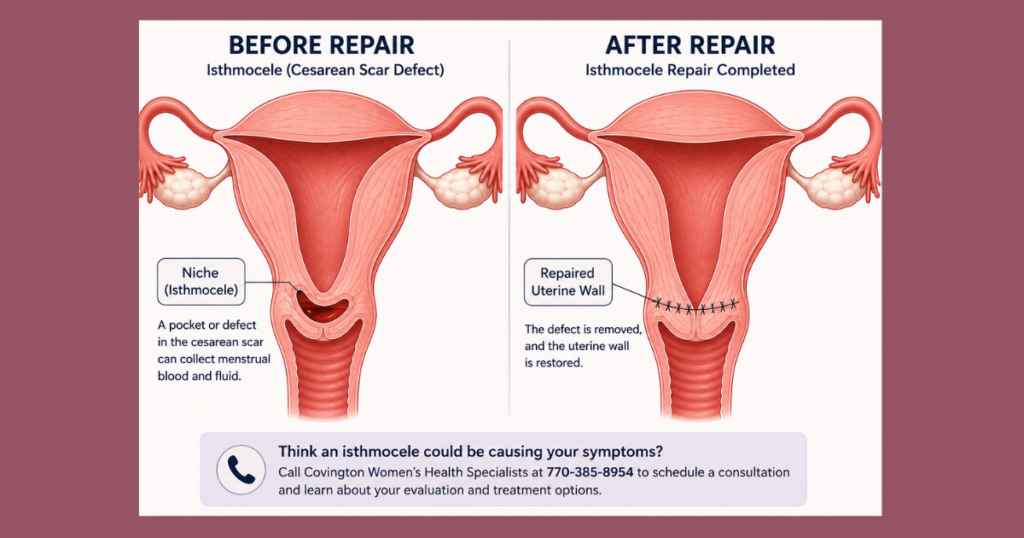
Most women who have a Cesarean section heal without long-term complications. However, for some, the incision in the uterus does not heal completely, leaving behind a small pocket or indentation called an isthmocele, also known as a Cesarean scar defect.
As a board-certified OB/GYN with an American Board of Obstetrics and Gynecology (ABOG) Focused Practice Designation in Minimally Invasive Gynecologic Surgery (MIGS), I frequently evaluate women with complex gynecologic conditions that are often overlooked. An isthmocele is one of those conditions. Although many women have never heard of it, it can be a treatable cause of abnormal bleeding, pelvic pain, infertility, and even unsuccessful embryo transfers during fertility treatment.
What Is an Isthmocele?
An isthmocele is a defect that develops in the scar from a previous Cesarean delivery. Instead of healing into a smooth, strong layer of muscle, the scar forms a small pouch, or “niche,” in the lower part of the uterus.
This pocket can collect menstrual blood after your period, which may lead to prolonged spotting and other symptoms.
Not every Cesarean scar defect causes problems. In fact, many women have small defects and never experience symptoms. However, when an isthmocele becomes symptomatic, treatment may be appropriate.
What Symptoms Can an Isthmocele Cause?
Women with an isthmocele may experience:
- Spotting for several days after their menstrual period has ended
- Irregular vaginal bleeding
- Pelvic pain or pressure
- Pain during intercourse
- Chronic pelvic discomfort
- Difficulty becoming pregnant after a previous Cesarean delivery
- Difficulty achieving pregnancy through IVF as an isthmocele may allow fluid to collect within the uterine cavity, which can interfere with embryo implantation
- Certain pregnancy complications related to the Cesarean scar in future pregnancies
Because these symptoms can also occur with other gynecologic conditions, an isthmocele is often overlooked or diagnosed years after symptoms begin.
How Is It Diagnosed?
Diagnosis starts with a conversation about your symptoms and medical history, especially if you have had one or more Cesarean deliveries.
Your physician may recommend one or more imaging tests, including:
- Pelvic ultrasound
- Saline infusion sonography (SIS)
- MRI in selected cases
- Hysteroscopy, a procedure that allows your physician to look inside the uterus with a small camera
These tests help determine the size of the defect and the thickness of the remaining uterine muscle, which helps guide treatment decisions.
When Is Surgery Recommended?
Not every isthmocele requires surgery.
Treatment depends on several factors, including:
- How bothersome your symptoms are
- Whether the defect may be contributing to infertility or unsuccessful embryo transfers during IVF
- The size of the scar defect
- The amount of healthy uterine muscle that remains
For women with significant symptoms, infertility, or recurrent unsuccessful embryo transfers that may be related to an isthmocele, surgical repair may be recommended after a thorough evaluation.
What Is a Robotic-Assisted Laparoscopic Isthmocele Repair?
A robotic-assisted laparoscopic isthmocele repair is a minimally invasive procedure performed through several small incisions in the abdomen.
During surgery, the damaged scar tissue is removed, and the healthy muscle of the uterus is carefully reconstructed to restore the strength and shape of the uterine wall.
Although the word “robotic” can sound intimidating, the robot does not perform the surgery on its own. Your surgeon is in complete control throughout the procedure. The technology helps perform complex repairs through a few small incisions instead of one large abdominal incision. For many women, this means less pain after surgery, a shorter recovery, smaller scars, and a quicker return to normal activities.
Why Specialized Training Matters
Repairing an isthmocele is a highly specialized procedure that requires advanced minimally invasive surgical skills and precise reconstruction of the uterus.
The Focused Practice Designation in Minimally Invasive Gynecologic Surgery (MIGS) is an advanced credential awarded by the American Board of Obstetrics and Gynecology to surgeons who have demonstrated additional expertise in complex minimally invasive gynecologic surgery.
This advanced training allows me to offer patients sophisticated surgical options, including robotic-assisted repair of Cesarean scar defects, when appropriate.
Could an Isthmocele Be Causing Your Symptoms?
If you’ve had one or more Cesarean deliveries and experience persistent spotting after your period, pelvic pain, difficulty becoming pregnant, or repeated unsuccessful embryo transfers, an isthmocele may be the underlying cause.
Many women live with these symptoms for years without realizing there may be an explanation—and an effective treatment. At Covington Women’s Health Specialists, we believe every woman deserves to have her symptoms taken seriously. If you think you may have an isthmocele or have been told you have a Cesarean scar defect, schedule a consultation to learn whether a minimally invasive evaluation and treatment plan may be right for you.